
Bruno Guimarães Would Give Arsenal the Midfield Edge Champions Need

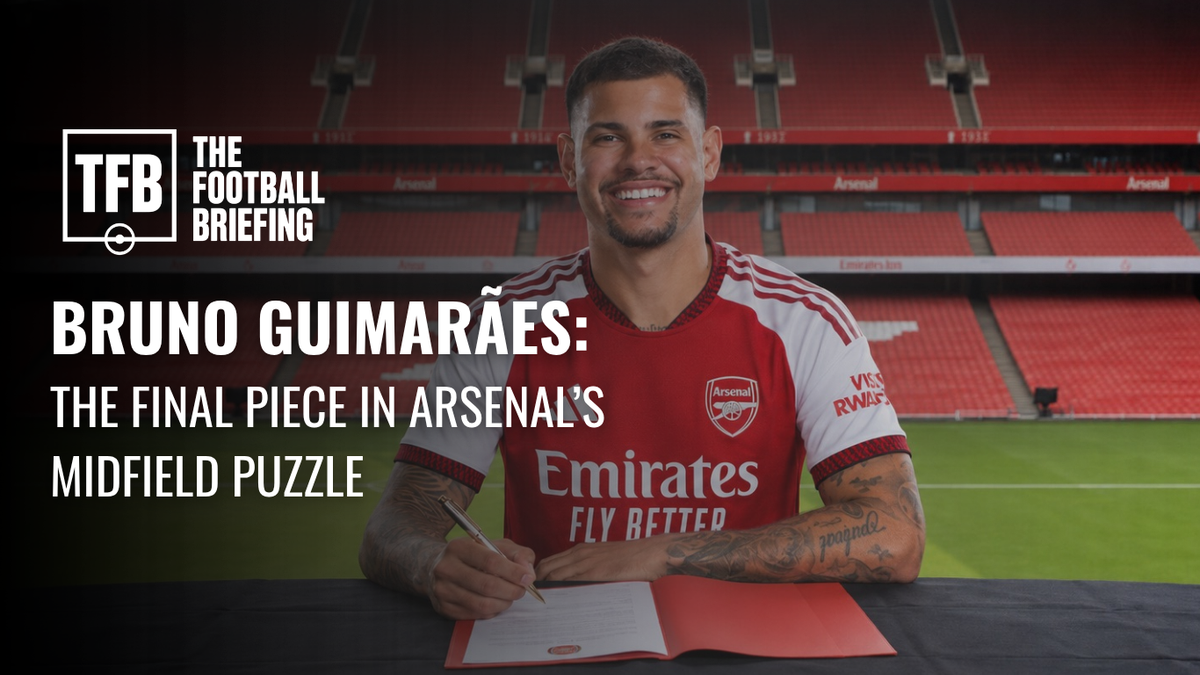
Arsenal are no longer building towards being taken seriously. That part of the project has been completed. Mikel Arteta’s side ended their 22-year wait for a Premier League title in May, finishing the job after three seasons of near-misses and establishing themselves as the standard others now have to chase.
That changes the transfer conversation. Arsenal are not looking for rescue signings. They are looking for marginal gains at the very top of the game. Bruno Guimarães fits that category because he would not simply add another high-level midfielder. He would alter how Arsenal can use the midfielders they already have.
The public situation still needs caution. There is no confirmed deal, and Sky Sports’ newspaper round-up has framed the Arsenal links as reported transfer gossip rather than a completed move. Newcastle’s position is strengthened by the fact Guimarães signed a five-year contract in 2023, committing him to the club until 2028.
That is an important starting point, because the interesting part of this story is not whether Arsenal can manufacture a transfer saga. It is why the player profile makes such strong football sense.
Guimarães is not just a decorative possession midfielder. He is a rhythm-setter with edge. At Newcastle, he has carried responsibility in almost every phase: receiving under pressure, progressing play, competing in duels, controlling tempo and giving Eddie Howe’s side emotional force when matches become stretched. Newcastle’s own profile notes that he was named club captain and won their official Player of the Year award for 2025/26.
For Arsenal, that matters because their midfield puzzle is already high quality but still highly specific. Declan Rice gives them power, range and defensive authority. Martin Zubimendi, who joined Arsenal from Real Sociedad in 2025, gives them a more natural controller at the base of midfield. Martin Ødegaard remains the creative reference point on the right side.

The question is not whether that trio is good enough. It clearly is. The sharper question is whether Arsenal have enough variation around it to dominate different types of elite matches.
Their Champions League final defeat to Paris Saint-Germain provided the clearest example of the next step. Arsenal were competitive, disciplined and extremely difficult to break down, but PSG dominated possession after Arsenal’s early goal and eventually won on penalties after a 1-1 draw. Reuters reported that Arteta spoke afterwards about needing to be “very ambitious, very fast and very smart” to reach another level.
Guimarães would give Arsenal another way to play those games. He can operate as a six, an eight, or as part of a double pivot. He is comfortable enough on the ball to help Arsenal build through pressure, but combative enough to prevent their midfield from becoming too neat. That balance is why he would be more than depth.
With Rice, the fit is especially interesting. Rice has become one of Arsenal’s most valuable players because he can do several jobs at once, but that versatility can also become a burden. When he is the main ball-winner, the left-sided runner, the set-piece weapon and the transition firefighter, Arsenal ask an enormous amount of him. Guimarães would allow Arteta to reduce that load without reducing intensity.
In some matches, Rice could push higher knowing Guimarães can hold central space. In others, they could form a more rugged double pivot, giving Arsenal greater security against teams who attack quickly through the middle. Against the best sides in Europe, that extra layer can be the difference between control and survival.
The Zubimendi relationship would be different. It would not be about duplication. Zubimendi is a calmer metronome, the sort of midfielder who gives structure to possession. Guimarães is more confrontational, more likely to carry the ball through contact and change the temperature of a game. Together, they could give Arsenal both order and bite.
That is the missing dimension. Arsenal have often looked at their best when their midfield has a clear division of labour. The danger, as the squad develops, is becoming too dependent on one ideal version of the team. Guimarães would allow Arteta to rotate between shapes without sacrificing the standards of the system.
He would also help Arsenal in matches where Ødegaard is heavily marked. Opponents have learned that denying Ødegaard time on the ball can slow Arsenal’s right-sided combinations. Guimarães would offer another central player capable of receiving in tight areas, drawing pressure and finding the next pass. That does not replace Ødegaard’s creativity; it protects it.
There is also a psychological element. Arsenal’s recent progress has been built on technical improvement, but also on a harder competitive personality. Rice brought that. William Saliba and Gabriel give them it in defence. Guimarães would add another player who does not drift through big matches. He engages with them.
That edge can be valuable, provided it is managed. Guimarães plays close to the emotional line, and Arsenal would have to absorb that part of the package. But top-level midfields are rarely made only of tidy passers. The best sides need players who can control a match when it is calm and survive it when it becomes chaotic.
The financial and strategic questions are real. Newcastle have no obvious reason to make this easy. Guimarães is their captain, one of their most influential players and under contract for two more years. Sky Sports reported earlier this year that speculation around both Guimarães and Sandro Tonali had grown after Newcastle’s Champions League exit, but also carried Eddie Howe’s public stance that Bruno was committed at that point.
Arsenal would also have to consider opportunity cost. A major midfield deal cannot be judged in isolation if it limits spending elsewhere. Title-winning squads still need freshness in attack, defensive cover and long-term succession planning. Guimarães would make sense only if Arsenal believe he raises the ceiling immediately without narrowing the rest of the window.
That is why this is not a simple “statement signing” argument. Arsenal have moved beyond the stage where expensive means ambitious by default. The right signing now is one who gives Arteta more answers in the most difficult matches.
Guimarães does that. He would not arrive as the saviour of a flawed midfield. He would arrive as the player who turns a strong midfield into a more adaptable one. He gives Rice freedom, Zubimendi protection, Ødegaard support and Arsenal a different form of control.
For a club trying to defend a Premier League title while closing the final gap in Europe, that is exactly the kind of improvement that matters. Not loud. Not reckless. Just smart, competitive and deeply suited to where Arsenal now are.