Cape Verde Are Not a World Cup Fairytale. They Are a Tactical Warning

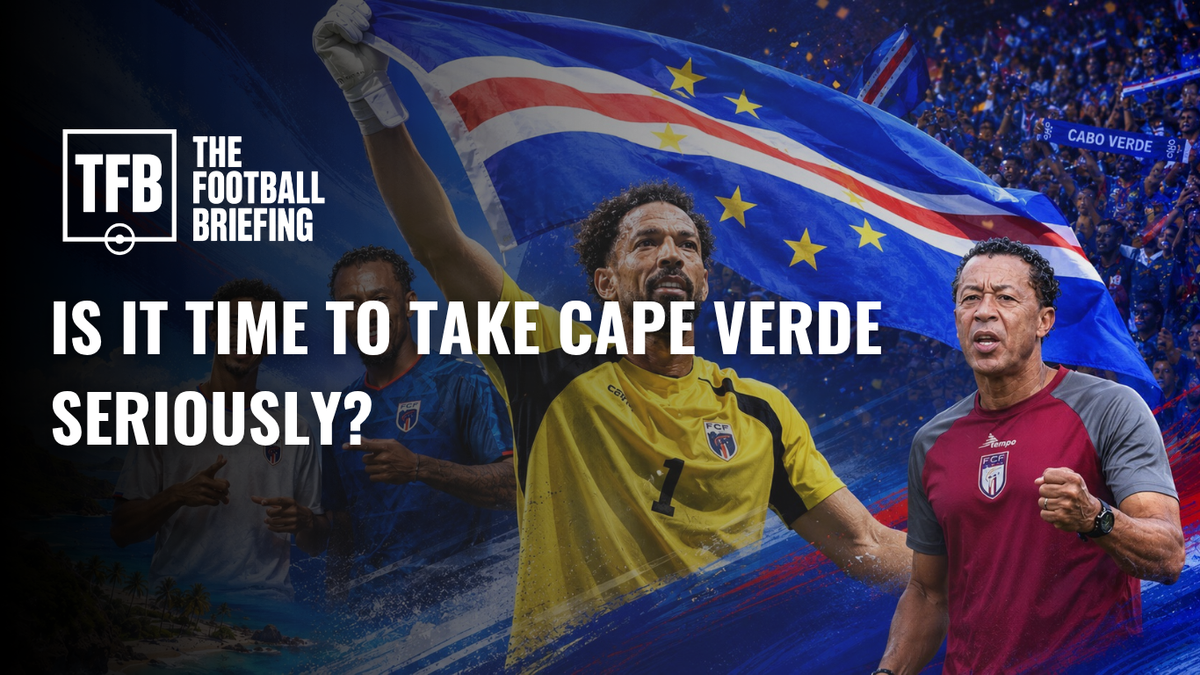
The temptation is to call Cape Verde’s World Cup run a fairytale and leave it there. The smallest nation by population to reach the knockout stages. Three group games, no defeats. A 40-year-old goalkeeper who went from relative anonymity to global celebrity in little more than a week. A squad dancing on the pitch while phones confirmed Spain’s victory over Uruguay and, with it, their own passage into the round of 32.
It is a beautiful story. It is also an incomplete one.
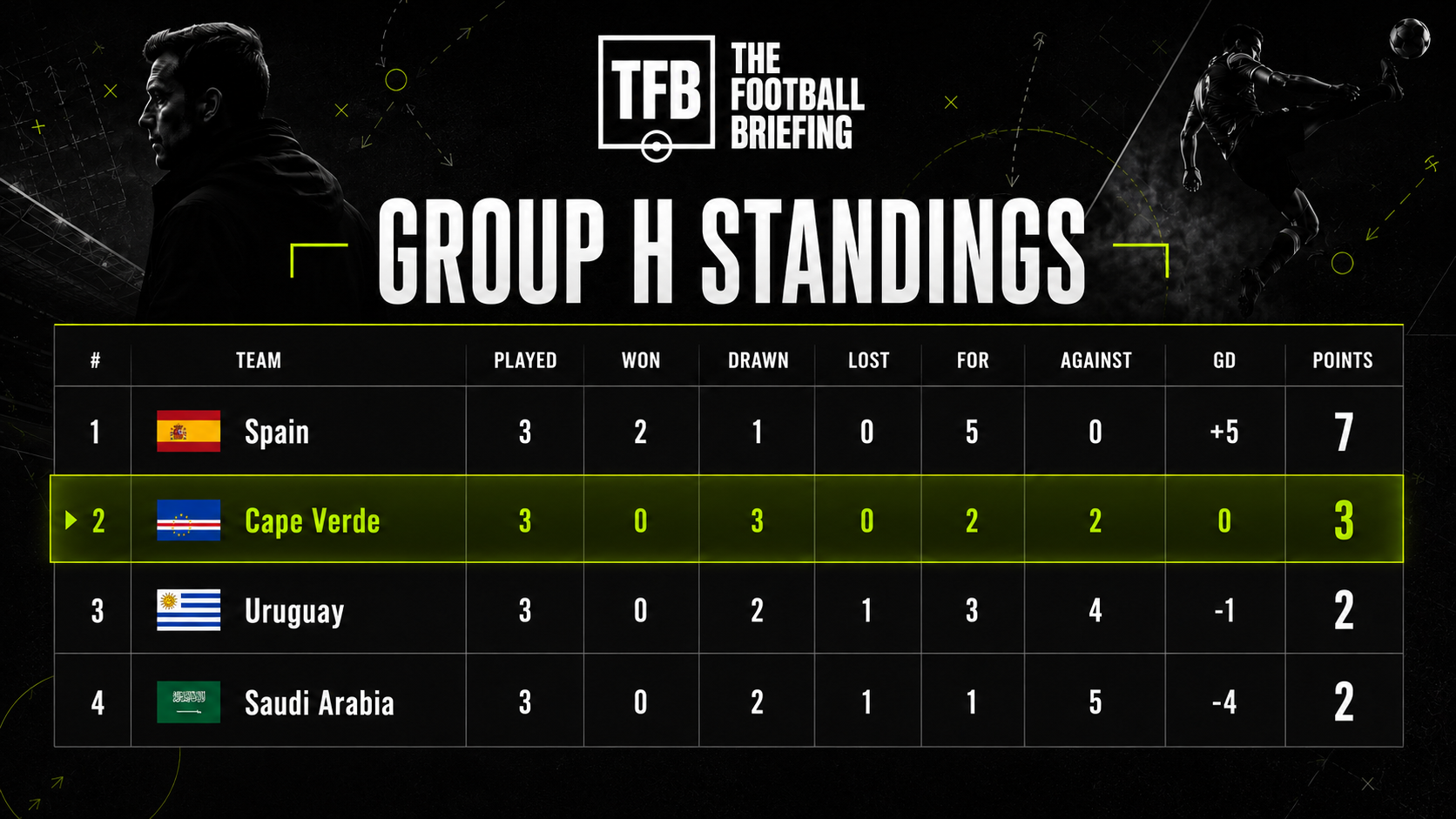
Cape Verde have not reached the knockouts because the football gods smiled on them three times. They have drawn 0-0 with Spain, drawn 2-2 with Uruguay and drawn 0-0 with Saudi Arabia. That left them second in Group H with three points, behind Spain and ahead of Uruguay and Saudi Arabia. Their reward is Argentina in Miami on 3 July, a tie that gives the whole run an almost cinematic next act. Yet the deeper truth is that Cape Verde have earned this through organisation, game intelligence and a collective refusal to let matches become the kind of contests their opponents wanted.
Three draws can look modest from a distance. In context, they are remarkable. Cape Verde have played the European champions, a Uruguay squad full of elite-level names and a Saudi side who still arrived at the final group game with something to chase. They have scored only twice, conceded only twice and finished with a goal difference of zero. That record tells you this has not been a tournament of domination. It has been a tournament of control under pressure.
The first point, against Spain, was presented in many places as a goalkeeping miracle. Vozinha made seven saves, Spain had 74% possession, 27 shots and 2.29 expected goals. On paper, that sounds like a siege. But the more revealing detail is that Cape Verde conceded only one foul, the fewest by any team in a World Cup match on record since 1966. That is not a random underdog statistic. That is defensive discipline under extreme stress.
Teams who are merely surviving tend to lunge, foul, panic and concede dangerous free-kicks around the box. Cape Verde did the opposite. They absorbed pressure without constantly breaking structure. They allowed Spain to have territory, but not emotional control. Spain’s 27 shots produced an average of roughly 0.085 xG per attempt, which points to volume rather than a stream of clear chances. Cape Verde did not stop Spain shooting; they made Spain shoot in ways that kept Vozinha involved rather than helpless.
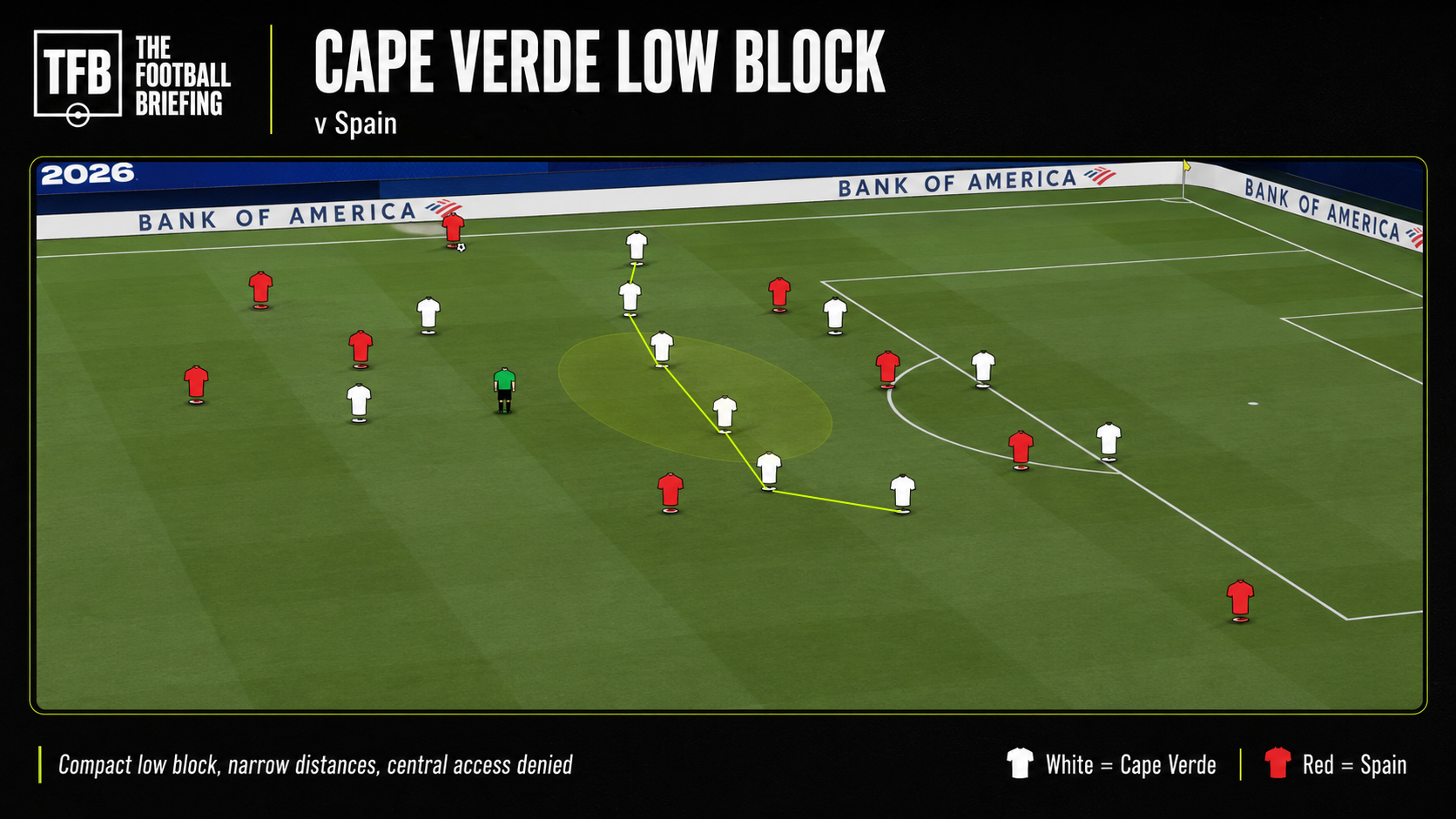
That distinction matters. Goalkeepers can win matches, but they cannot build a defensive plan alone. Vozinha was magnificent, especially when Spain accelerated late in the first half and again after Lamine Yamal was introduced. Yet the platform for his performance was the shape in front of him. Cape Verde’s midfield line denied easy central combinations, the wide players recovered into narrow positions when Spain switched play, and the centre-backs resisted the urge to chase too aggressively into midfield.
Against Spain, Cape Verde’s block often looked like a 4-1-4-1 when defending settled possession, with the deepest midfielder screening the lane into the striker and the two central midfielders shuffling across to prevent Spain finding the half-spaces cleanly. The important part was not the nominal formation, but the spacing. The distances between full-back, winger and central midfielder were short enough to prevent Spain creating easy two-v-one overloads. When the ball went wide, Cape Verde did not always jump to press. They delayed, narrowed the angle and trusted the next defender to cover.
That is why the Spain game should not be remembered only as the night Vozinha became a star. His social media following was reported to have jumped from around 50,000 to more than 16 million after his early performances, and that personal story understandably caught global attention. But Cape Verde’s achievement was bigger than one man’s viral rise. Vozinha became the face of the run because goalkeepers are the last image of resistance. The system in front of him made that resistance repeatable.
The Uruguay game then showed that Cape Verde were not simply a low-block team waiting for heroic saves. They were behind on the balance of chances, yes. Uruguay had 17 shots and 2.34 xG, while Cape Verde had 12 attempts worth 0.86 xG. But Cape Verde got four shots on target to Uruguay’s two, which tells its own story about the precision of their moments. Uruguay created more danger in total. Cape Verde made their smaller attacking windows count.
Kevin Pina’s 32-metre free-kick was not just Cape Verde’s first World Cup goal. It was the first time since records began in 1966 that a nation’s first World Cup goal had come directly from a free-kick. It was also the longest-range goal of the tournament at that stage. Again, that can be dressed up as romance, but it had a tactical function. Set pieces are not a luxury for underdogs; they are a route to parity. Cape Verde know they will not create ten clear chances against elite opponents. Their dead-ball quality has to turn territorial scraps into scoreboard pressure.
The second goal against Uruguay, scored by Hélio Varela, came from alertness rather than aesthetic construction. He had only been on the pitch for just over two minutes, making it the fastest goal by an African substitute in a World Cup match since Roger Milla in 1994. That detail matters because Cape Verde’s bench has not been passive. Bubista has used substitutions to keep legs in transition, refresh pressure around the ball and maintain the emotional intensity of the team. Varela’s equaliser was opportunistic, but the readiness to attack a mistake is part of tournament football.
The Saudi Arabia draw may have been the least dramatic on paper, but it was arguably the most mature. Cape Verde entered that match no longer playing with pure freedom. They had something to protect. They also knew the other game in the group, Spain against Uruguay, could shape their fate. That is a dangerous psychological space for an inexperienced tournament side. Push too hard and the match opens. Sit too deep and anxiety takes over. Cape Verde did neither for long stretches.
The 0-0 in Houston was tense, but not passive. ESPN’s match data had Cape Verde winning the xG battle 1.52 to 0.40, and the late chances reflected that. Laros Duarte’s one-on-one in the 74th minute, Nuno da Costa’s stoppage-time chance and Cape Verde’s late counter-attacking threat showed a team still trying to win while understanding that a draw might be enough.
That is tournament intelligence. It is easy to praise bravery when it means attacking recklessly. Cape Verde’s bravery has been more sophisticated. They have been brave enough to defend without shame, brave enough to hold their shape while better-known players moved the ball around them, and brave enough to believe that one transition, one free-kick or one mistake could change the entire match.
Bubista deserves a great deal of credit for that. Pedro Leitão Brito is not coaching like a man seduced by the occasion. He is coaching like a former defender who understands the value of compactness, timing and collective patience. Reuters described him as a 56-year-old former defender, and his own post-match explanation was telling. He pointed to “organisation and team spirit”, then later to “unity and resilience”. Those are simple words, but they describe a very specific football idea: the team’s emotional structure and tactical structure are connected.
Before the tournament, Bubista had spoken about Cape Verde wanting to compete and bring their identity. That could have become empty pre-match language. Instead, the group stage has shown what that identity looks like. It is not a naive promise to attack everyone. It is a controlled form of ambition: stay in games, protect central space, keep distances short, maximise restarts, trust experienced players and never allow the match to drift into fatalism.
The tactical detail is important because Cape Verde’s resilience has not been vague. They have defended with a clear first priority: protect the centre. Against Spain, that meant allowing circulation outside the block while denying clean access between the lines. Against Uruguay, it meant accepting periods without the ball but staying alive for direct counters and set pieces. Against Saudi Arabia, it meant preventing the match from becoming frantic, even when the crowd and the live group table gave every passage of play extra weight.
Their defensive behaviour has also been unusually clean. After two games, Opta recorded that Cape Verde had conceded only five fouls, the fewest by any team across the opening two matches of a World Cup since 1966. That is a striking number. It suggests a side that defends through positioning rather than desperation. Fouls are often a sign that a team has arrived late to the ball. Cape Verde have often arrived early to the space.
Vozinha remains the headline figure, and rightly so. At 40, he became the oldest goalkeeper to keep a clean sheet on his World Cup debut, saving all seven Spain shots on target. He then added further decisive moments against Saudi Arabia, including a late stop from Abdullah Al-Hamdan. But his importance goes beyond shot-stopping. A low or mid-block team needs a goalkeeper who reduces panic. Vozinha’s presence allows defenders to hold the line a second longer, to block rather than dive in, to know that if the first shot comes through, it is not automatically fatal.
Ryan Mendes gives the team a different kind of authority. He is not simply an attacking outlet. He is the emotional reference point, the senior forward who gives Cape Verde’s possession a first destination when they need to breathe. CAF highlighted him before the tournament as one of the squad’s most experienced figures and Cape Verde’s key attacking leader. In a team that spends long spells without the ball, that kind of player is vital. A clearance becomes a possession only if someone can secure it. A counter-attack becomes a threat only if the first pass sticks.
Kevin Pina has been central to the balance. His free-kick against Uruguay will be replayed for years, but his broader value is in midfield coverage, ball-carrying and the ability to move Cape Verde up the pitch without losing the team’s structure. He is the sort of player who matters most in the moments between phases: after the first clearance, before the opposition counter-press arrives, when the choice is either to panic the ball forward or turn pressure into territory.
Around him, Jamiro Monteiro and Deroy Duarte have helped Cape Verde avoid becoming too flat in midfield. Duarte’s performance against Saudi Arabia was significant because he gave the side energy in the zones where matches are often lost by underdogs: second balls, loose clearances, transitional duels and the first pass after regain. Laros Duarte’s late impact from the bench also showed why Bubista’s squad management has mattered. Opta recorded him creating three chances despite only coming on in the 71st minute against Saudi Arabia.
At the back, Pico Lopes has come to symbolise the unglamorous work behind the story. The blocks, covering runs and aerial contests are not as easily packaged as Vozinha’s saves, but they are the reason Cape Verde have been able to survive long defensive spells without collapsing. The defensive unit has not been perfect. Uruguay did create enough to win that match on chance quality. Spain did generate pressure. Saudi Arabia did force late anxiety. But Cape Verde’s back line has rarely looked emotionally broken, and that is a major part of tournament defending.
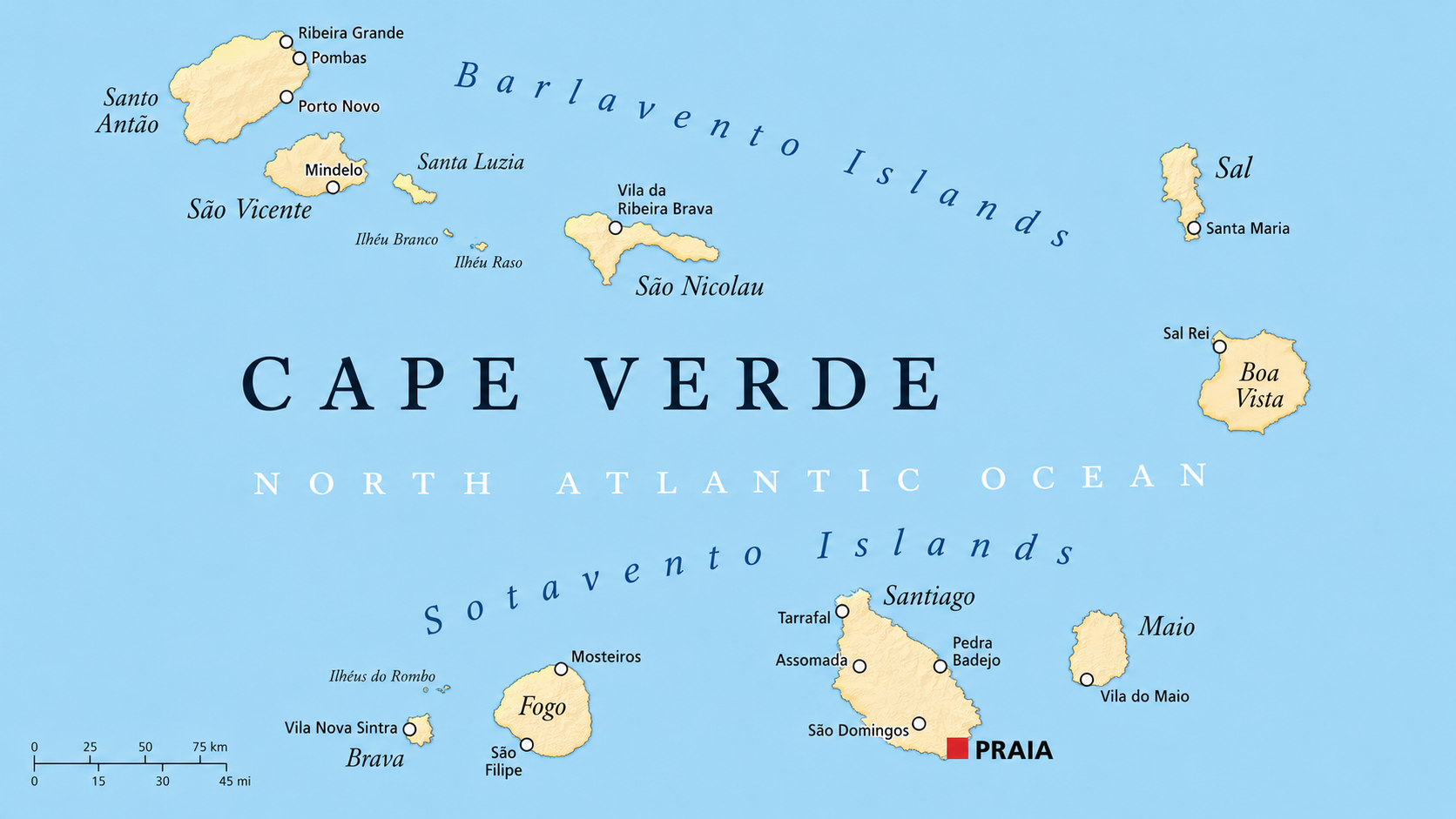
The national context makes the achievement larger without needing to exaggerate it. Cape Verde, officially Cabo Verde, is a ten-island archipelago around 500 kilometres off Africa’s west coast, with the World Bank listing its 2024 population at 524,877. Its football identity is therefore built from limited domestic scale, strong diaspora links and a national team that carries a country much bigger in feeling than in population.
That is why this run has resonated. Cape Verde’s success is not just about the scoreboard. It is about visibility. For a country often known internationally through tourism, music, migration and diaspora communities, the national team has become a moving symbol of recognition. The players are not only representing the islands; they are representing Cape Verdeans abroad, too. In that sense, every point has carried emotional weight beyond the group table.
Yet the football should remain at the centre of the story. Cape Verde’s rise did not start with the Spain draw. Their qualification itself was historic: they reached this World Cup by beating Eswatini 3-0 and finishing ahead of Cameroon in their qualifying group. That mattered because it showed the same qualities now visible on the world stage: recovery from setbacks, trust in Bubista and a capacity to beat more established football nations over a longer campaign, not just in one emotional match.
Argentina now present a different level of test. Spain asked Cape Verde to defend possession. Uruguay asked them to survive direct attacking quality and physical momentum. Argentina will ask more subtle questions. They are the reigning champions, and their greatest strength is not just individual brilliance but rhythm manipulation. They can slow a game, pull a block a few yards too high, then accelerate through the space that appears.
Cape Verde’s plan against Argentina has to be even more precise than it was against Spain. They cannot afford cheap fouls around the box. They cannot let the space between midfield and defence become a receiving zone. They cannot lose concentration after clearances, because Argentina are excellent at turning recycled attacks into second-wave chances. The first defensive action will not be enough. The second and third actions will decide whether Cape Verde stay alive.
Their route to an upset is narrow but real. First, keep the opening half-hour scoreless. That would deepen the emotional pressure on Argentina and give Cape Verde the one thing underdogs need most: time in the game. Second, make Argentina’s possession horizontal. If Cape Verde can force switches without allowing central penetrations, they can make the match slower and more frustrating. Third, turn every restart into an event. Pina’s delivery and shooting range, Mendes’ experience, and the aerial presence of the centre-backs could make set pieces Cape Verde’s best attacking weapon.
The danger is that Cape Verde’s lack of open-play chance volume may eventually catch up with them. Across the group, they have been efficient rather than prolific. Two goals in three games is enough when the defensive structure holds, but knock-out football can force teams into uncomfortable territory. If Argentina score early, Cape Verde may have to chase. If they chase, the spaces open. If the spaces open, the contest becomes much less suited to their strengths.
That is why the realistic judgement has to be balanced. Cape Verde can trouble Argentina. They can make the match awkward, tense and much closer than reputations suggest. They can reach half-time level and make the world champions feel the weight of the story. But to go much further, they would need either another exceptional goalkeeping performance, another set-piece moment, or their best attacking display of the tournament.
Still, that should not reduce what they have already done. Cape Verde have given this World Cup one of its great early stories, but more importantly, they have given it one of its clearest tactical lessons. Small nations do not have to be passive to be disciplined. They do not have to be lucky to be resilient. They do not have to dominate possession to control the emotional direction of a match.
Their grit has been infectious because it has been organised. Their determination has mattered because it has been channelled. Their unbeaten group stage has not been built on chaos, but on clarity.
Cape Verde are not just the smallest nation to reach this stage. They are a reminder that at a World Cup, identity can still close gaps that budgets, reputations and rankings insist should be too wide.