England’s right-back dilemma has become the Trent question Tuchel hoped to avoid

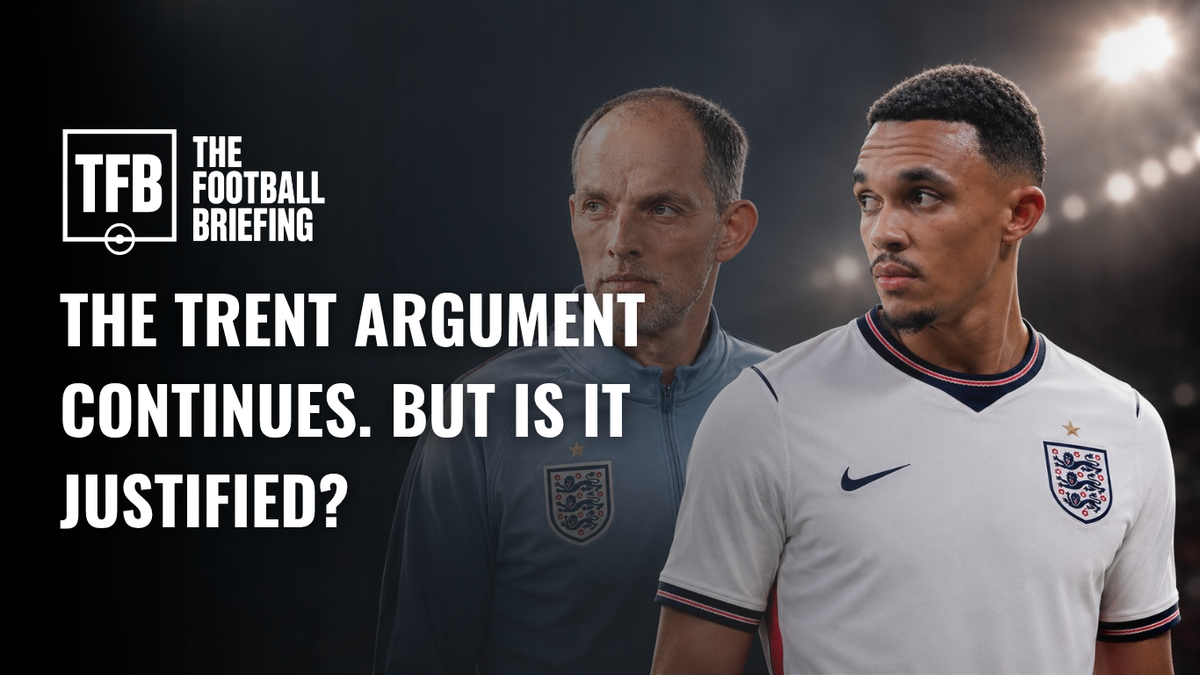
Thomas Tuchel’s decision to leave Trent Alexander-Arnold out of England’s World Cup squad was always going to follow him. It only needed a trigger.
Reece James’ hamstring injury has supplied it.
James did not travel for England’s final Group L game against Panama, with Tuchel confirming a “minor hamstring injury” and saying the Chelsea captain is on an “accelerated rehab programme”. England hope he can return later in the tournament, but Tuchel also admitted they must now “look for solutions”.
With James fit, leaving Alexander-Arnold at home could be framed as ruthless but coherent. James offered Tuchel a two-way right-back he trusts. Tino Livramento offered athletic cover. Djed Spence brought Premier League minutes and flexibility. Jarell Quansah, Ezri Konsa and Trevoh Chalobah gave him emergency options.
Now James is unavailable and Livramento has already withdrawn with a calf injury. England’s official squad update confirmed Chalobah replaced Livramento after the Newcastle full-back was ruled out before the opening game.
So the question has sharpened: if England are now improvising at right-back, why was the most gifted English right-back of his generation left in Madrid?
The tempting answer is politics. A personal issue. A personality concern. Something behind the scenes. The evidence points more clearly towards a tactical trust issue than a relationship breakdown.
This does not look like a feud
There is no strong public evidence of a personal rupture between Tuchel and Alexander-Arnold.
When Tuchel explained the omissions of Alexander-Arnold, Phil Foden, Cole Palmer and Harry Maguire from the final 26, he said there had been “difficult phone calls” and added: “I respect all of them. As players, personalities.” He also said those players had been “excellent” when they had been in camp.
That sounds less like a manager distancing himself from a player than one defending a selection call he knew would be unpopular.
There was direct communication, too. In August 2025, after another Alexander-Arnold omission, Tuchel said he had spoken to him personally and wanted him to hear the decision from him. According to Tuchel, Alexander-Arnold made clear he was “desperate” to return and play for England.
That matters. It undercuts the idea that Alexander-Arnold has checked out of England duty, and offers no real support for the theory that the relationship is broken.
The more awkward detail is Tuchel’s comment that Alexander-Arnold “needs to feel trust and love” from his manager, team-mates, club, country and supporters. That could be read as a personality observation, but it is not proof of a problem. Managers often talk about what different players need psychologically. Tuchel’s point seemed more about how to get the best from Alexander-Arnold than why he could not be managed.
As for Alexander-Arnold himself, there does not appear to be a verified public quote in which he directly criticises, or even meaningfully discusses, Tuchel. The closest public record is Tuchel’s own account of their conversations. Anything stronger would be speculation dressed up as insight.
Tuchel has told us the tactical concern
The best evidence is not hidden. Tuchel has said it out loud.
In May 2025, when discussing Alexander-Arnold’s England role, Tuchel praised his quality but made the concern clear. He said he could see that Alexander-Arnold sometimes “relies heavily on his offensive contributions” and gives less emphasis to “defensive discipline and effort”. He added that Alexander-Arnold had to take the defensive part of the game “very seriously”.
That is the core of the decision.
Tuchel knows what Alexander-Arnold can do. In March 2026, he said: “I know very well what Trent can offer us.” He spoke about having suffered against him when Alexander-Arnold played for Liverpool, but still said he had stuck with Livramento, Spence and Quansah because they had given him evidence in camp and offered a “slightly different profile”.
The wording matters. Tuchel did not say Alexander-Arnold lacks talent. He did not say he cannot pass, create or influence a game. He said other players better fitted the role.
That also fits his broader squad-building logic. On England’s official channels, Tuchel said tournament football is about “the team and the chemistry” and that “the best group is not necessarily the 26 most talented players”. He also asked the central selection question: “Who do we really trust?”
Alexander-Arnold is clearly one of England’s 26 most talented footballers. The decision suggests Tuchel did not see him as one of the 26 most suitable for the roles he wanted covered.
The data explains both sides
Using 2025/26 league-campaign data, the comparison is not a simple win for either side. It explains why Tuchel may prefer James. It also shows what England lose without Alexander-Arnold.
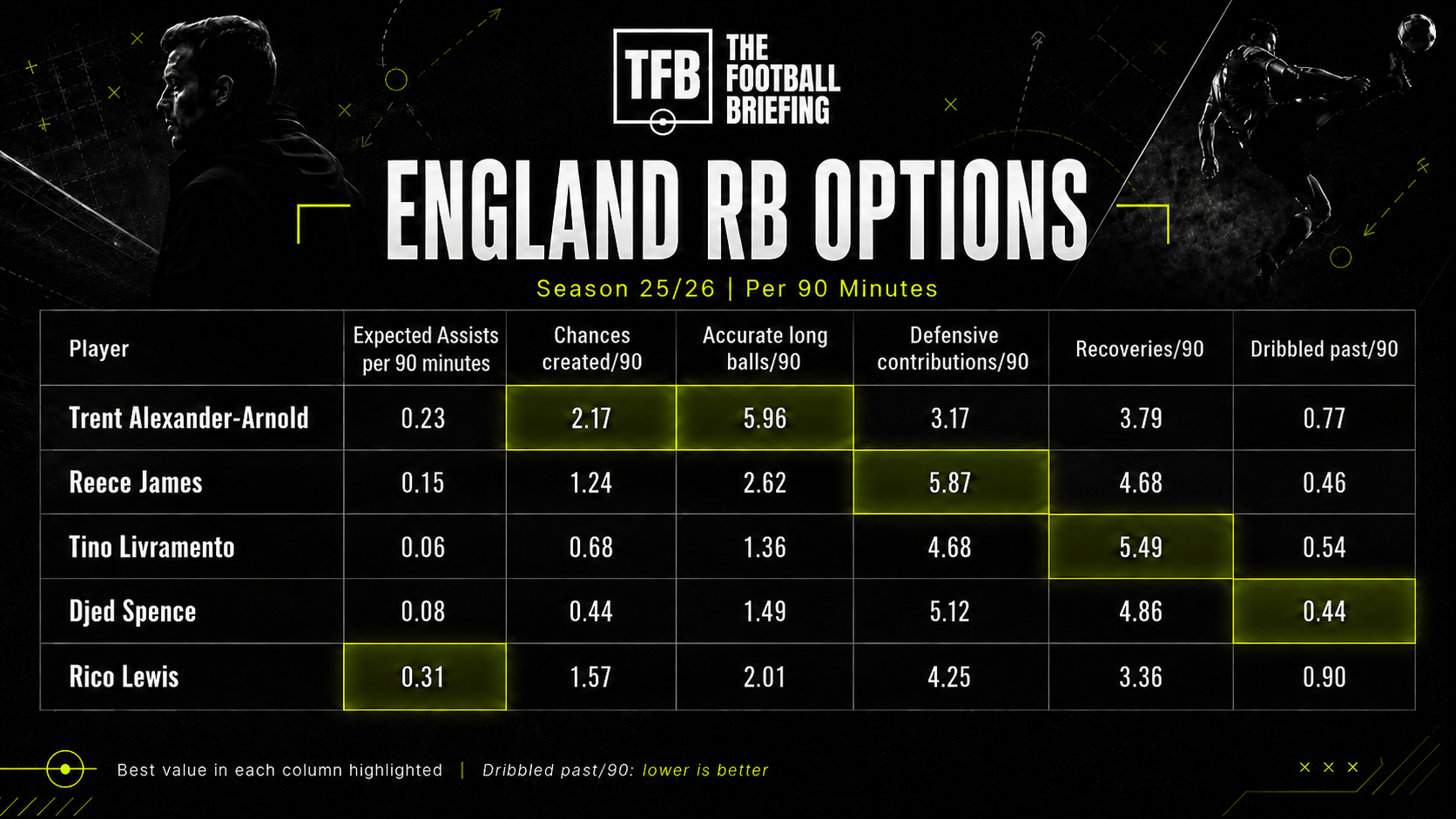
The first thing the data says is that James was a logical first-choice right-back. He matches Alexander-Arnold for assists, has the best pass completion, the best duels-won percentage, the highest tackles per 90, the highest defensive contributions and a strong recovery profile. A fit James gives Tuchel a route to balance: technical security, physical authority, crossing, set-piece quality and defensive reliability.
The second thing it says is that Alexander-Arnold remains unique.
He leads the group for chances created, accurate long balls and successful crosses. His long-ball figure is especially striking: 5.96 accurate long balls per 90, compared with James at 2.62, Lewis at 2.01, Spence at 1.49 and Livramento at 1.36. This is not just about crossing. It is about changing the angle of attack early, finding the far-side winger, releasing runners and forcing compact opponents to defend the full width of the pitch.
That is the part England may miss.
Against elite transition teams, Tuchel may not want Alexander-Arnold defending large spaces with limited cover. Against a low block in a knockout game, he might badly want the passing range he left at home.
What Tuchel probably wants from his full-backs
Tuchel’s selections suggest he wants his full-backs to do three things before anything else: secure the rest defence, survive duels and protect the team when possession breaks down.
That preference is visible in the players he picked. James, when fit, is the cleanest two-way option. Livramento offers recovery pace and flexibility on both sides. Spence gives running power, physicality and defensive volume. Quansah and Konsa are not natural attacking full-backs, but both can operate as conservative right-sided defenders in a back four that becomes a three in possession.
Alexander-Arnold changes the geometry of the team. To maximise him, England would probably need to give him licence to receive in advanced or inverted positions, then protect the space behind him. Liverpool did that at their best. Real Madrid can absorb some of that risk because their technical level is so high and their attacking dominance can pin teams back.
International football is less forgiving. Patterns are less rehearsed. Training time is limited. Players arrive from different club systems. One lost duel or late recovery run can decide a knockout match.
Tuchel has been explicit that his squad was selected for roles, not simply names. Reuters reported him saying he wanted specialists for different scenarios: leading, chasing, set-pieces, penalties and leadership.
The puzzle is that Alexander-Arnold looks exactly like a specialist for one of the most important scenarios of all: England needing to break down a stubborn opponent.
So who is actually the best right-back?
It depends on the job.
If the job is to start a World Cup knockout game against dangerous wide forwards, James is the best all-round option on this data. He gives England the most convincing blend of passing security, duels, defensive volume and attacking output. Tuchel’s trust in him is supported by the numbers.
If the job is to protect the right side without James, Spence has a case. He played 2,056 Premier League minutes, more than anyone else in this comparison, and his defensive volume is strong. His pass completion and creative output are much lower, but he looks like a more natural fit if Tuchel wants a runner and defender rather than a playmaker.
If the job is to recover loose balls, cover both full-back positions and play with athletic discipline, Livramento’s data is good. His 55.0 per cent duel success and 5.49 recoveries per 90 stand out. The problem is availability. He is no longer in the squad.
If the job is to invert into midfield, receive under pressure and combine in tight spaces, Rico Lewis is interesting, but the sample is small. Four Premier League starts and 402 minutes is not enough to build a World Cup case around, even with strong creative per-90 numbers.
If the job is to solve a tight game with passing, Alexander-Arnold is the best option by a distance.
That is the dilemma. Tuchel appears to have selected for the first job. James’ injury has made the fifth feel more urgent.
Was Tuchel right to leave Trent out?
Before James’ injury, the decision was defensible. Harsh, certainly. Conservative, too. But defensible.
Tuchel had a clear football argument. James was ahead as the all-rounder. Livramento and Spence suited the athletic and defensive demands of the role. Quansah and Konsa gave him emergency structural cover. Alexander-Arnold’s data showed elite creativity, but also lower duel success than James or Livramento, fewer defensive contributions and a profile that requires protection.
After James’ injury, the decision looks more fragile.
Not wrong by hindsight alone. Managers cannot select squads by predicting exactly which hamstring will go and when. But tournament selection is partly about risk management, and England took a clear risk. They left out their most creative right-back while selecting a group containing James, whose injury history was already a known concern, and Livramento, who did not make it to the opening match.
The balanced verdict is this: Tuchel was right to see James as England’s best tournament right-back, but wrong to leave himself without Alexander-Arnold as a specialist alternative.
England do not need Alexander-Arnold to start every game. They do not need to pretend his defensive weaknesses are imaginary. They do not need to distort the whole team around him.
But World Cups are often decided by awkward game states. Thirty minutes against a deep block. A quarter-final drifting towards penalties. A match where England have possession but no incision. A game where the obvious combinations have become too slow and predictable.
In those moments, Alexander-Arnold is not a luxury. He is a solution.
Tuchel can still be vindicated. If England remain compact, survive transitions and find enough creativity through Jude Bellingham, Bukayo Saka, Morgan Rogers, Eberechi Eze and the left side, the right-back debate will fade. Coaches are judged by the tournament, not the discourse around it.
But if England exit while chasing a goal, with a centre-back filling in at right-back and no elite passer to change the rhythm, the question will linger.
Not because Alexander-Arnold is perfect. Because England’s squad may now lack the one kind of imperfection that can win a World Cup match.