Tuchel Has Built England for the Games That Decide Tournaments


Thomas Tuchel’s England squad is not an accident of form, reputation or public mood. It is a tournament machine built backwards from the games England expect to face last: France, Spain, Brazil, Argentina, Portugal, Germany, the kind of opponents who do not give you 90 minutes to express yourself but five seconds to survive a transition, defend a back-post cross, win a penalty shootout or change a tight knockout tie from the bench.
That is the clearest way to understand the most controversial England squad selection in years. Phil Foden, Cole Palmer, Morgan Gibbs-White, Harry Maguire and Trent Alexander-Arnold are not absent because they lack quality. They are absent because Tuchel has decided that England’s best route to the World Cup is not to collect the most gifted footballers, but to pick the most useful roles.
Tuchel said as much when defending his squad, insisting England were trying to build “the best possible team” rather than simply pick “the 26 most talented players”. He also spoke of “specialists for different scenarios”, including leading, chasing, set-pieces and penalties. That phrase is the key to everything. This is not a squad designed to win an argument on social media. It is designed to win a quarter-final.
England’s group stage has already shown both sides of the project. The 4-2 win over Croatia suggested a side with greater attacking freedom and authority than England have often shown at major tournaments. The 0-0 draw with Ghana brought back an old anxiety: what happens when England dominate territory but cannot prise open a compact, stubborn opponent? England face Panama on Saturday, 27 June, knowing a win can secure top spot in Group L, after taking four points from their opening two matches.
The temptation after Ghana is obvious: reach for the missing artists. Palmer could find a moment. Foden could float between lines. Gibbs-White could add spite, invention and vertical passing. Trent could change the angle of attack from deep. All of that is true. It is also exactly the kind of debate Tuchel appears willing to absorb, because he is not building England for the romantic idea of control. He is building them for the ugly, late-stage version of it.
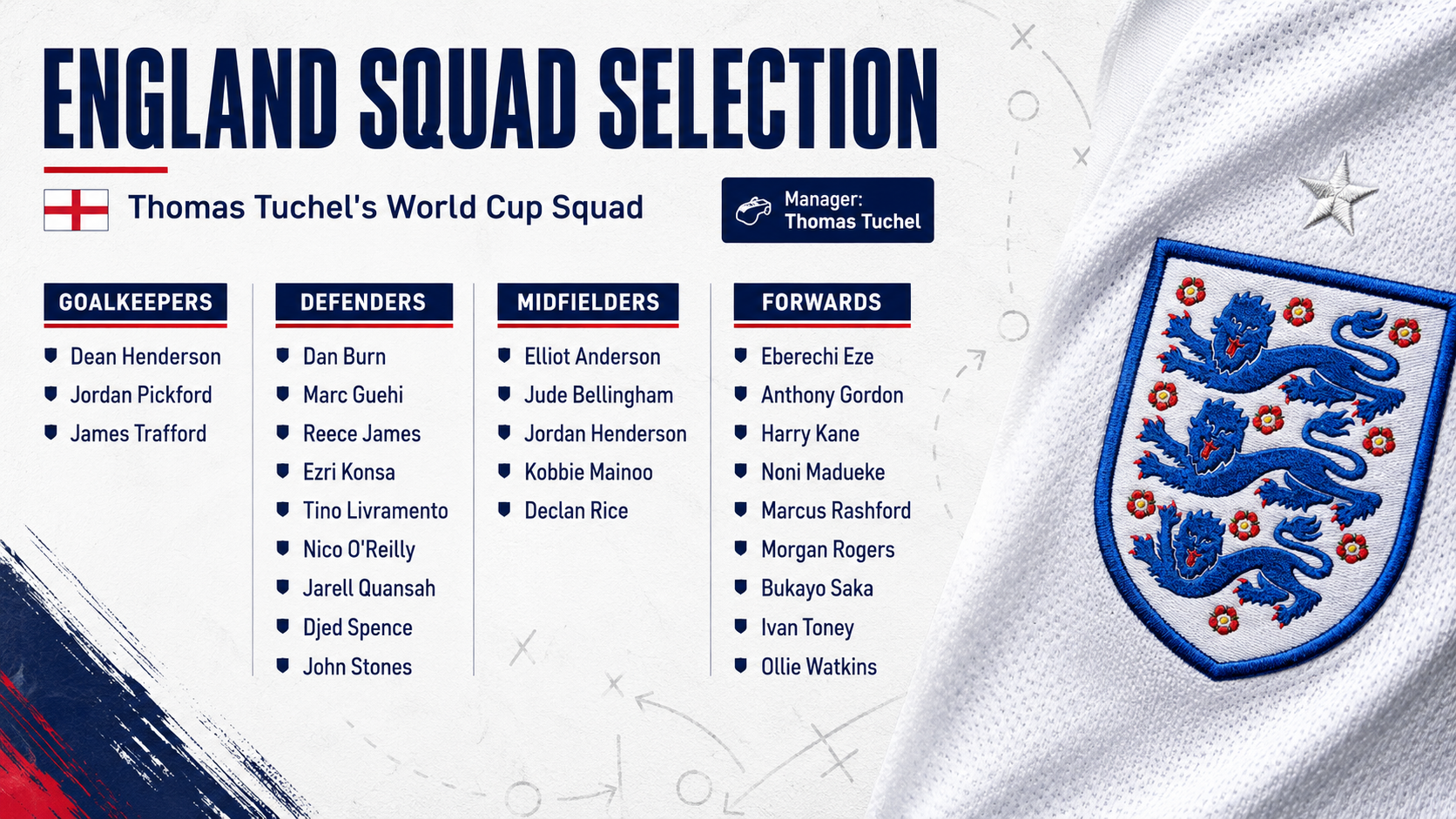
The Foden and Palmer omissions are the purest expression of that logic. Both are elite technicians. Both can receive in tight areas. Both have the ability to settle a game with one touch. But England already have Jude Bellingham, Morgan Rogers and Eberechi Eze occupying the creative midfield lane. Tuchel’s explanation was not that the excluded players had failed as footballers. It was that England could not carry “five No 10s” and then ask them to play out of position.
That matters because England have been here before. Under Gareth Southgate, tournament squads often became arguments about accommodation. Could Foden play from the left? Could Bellingham and Foden work together? Could Trent become a midfielder? Could all the talent fit if the structure bent enough? Tuchel has taken the opposite view. The structure comes first. The player either fits it clearly or he does not go.
Palmer’s absence is the hardest to defend emotionally, because he has the temperament that big moments usually demand. He scored England’s equaliser in the Euro 2024 final and plays with a rare calm. Yet his own response has been notably measured. Palmer told i-D, as reported by the Standard, that his season “hasn’t been the best” and said he was “not crying over a decision you can’t change”, while hoping England “make it all the way”.
That quote almost strengthens Tuchel’s case. Palmer is not a problem personality. He is not a luxury player in the lazy sense. He is simply a player who, in this squad build, lost a positional numbers game. Tuchel has chosen Bellingham as the emotional and tactical centre, Rogers as a powerful carrier who can connect midfield to attack, and Eze as a different kind of one-v-one creator. Once that decision was made, Palmer became a player England wanted but did not strictly need.
Foden’s case is slightly different. His best football comes when the ecosystem around him is precise, when rotations, distances and timing are familiar. At Manchester City, that has often made him devastating. In international football, where automatisms are thinner and tournament games are more chaotic, Tuchel appears unconvinced that Foden’s best role is obvious enough to justify another creative slot. The decision is ruthless, but not irrational.
Gibbs-White has the strongest argument on current rhythm. He has become a sharper, more decisive Premier League player and brings a confrontational edge England sometimes lack. His reaction underlined that frustration. He said he felt he had done “more than enough” and had ended up on the wrong side of “someone’s opinion”, while still respecting Tuchel for calling him personally.
But Gibbs-White, too, falls into the same tactical squeeze. Is he ahead of Bellingham? No. Does he offer Tuchel a clearer wide profile than Bukayo Saka, Anthony Gordon, Marcus Rashford or Noni Madueke? Not really. Is he a specialist substitute in the way Ivan Toney is? Again, probably not. That is the brutal part of this England squad. Tuchel has not picked the best debate. He has picked the clearest job descriptions.
Maguire’s omission is more structural. Under Southgate, Maguire was a symbol of tournament trust: aerially dominant, experienced, resilient and reliable in an England shirt even when club form wobbled. Tuchel has gone another way. He has favoured centre-backs and full-backs who can defend larger spaces, cover wide zones, offer recovery pace or build in cleaner patterns. Maguire said he was “shocked and gutted” and believed he could have played a major part, before wishing the squad well.
Tuchel’s response was revealing. He respected Maguire’s disappointment but said England had stood by the central defenders who had carried them through the September, October and November camps. He also praised John Stones as a “world-class player” and backed Djed Spence for his pace and one-v-one defending.
That explains why Maguire did not fit. It was not simply age, form or a lack of loyalty. It was the shape of the team Tuchel wants. Against elite opposition, England may need to hold a higher line, defend transitions, cover channels and survive periods without retreating into their own box. Maguire can still defend a box superbly. Tuchel wants defenders who can stop the game arriving there in the first place.
The Trent Alexander-Arnold question is the most fascinating because it cuts to the heart of what Tuchel values. Trent remains one of the best passers England have produced. But Tuchel’s England have prioritised repeatable defensive security at full-back. Sky Sports reported that Alexander-Arnold had not won a cap since last summer before being left out, while earlier reporting around Tuchel’s thinking placed Jarell Quansah ahead of him because of physicality, height, pace, aerial strength and build-up security.
That does not mean England are better passers without Trent. They are not. It means Tuchel has decided the right-back role in his England team is not primarily about being a playmaker. It is about defending the far post, covering the channel, matching speed in transition and giving England fewer weak points when the tournament reaches the stage where one flaw becomes the opposition’s whole game plan.
This is where the comparison with Southgate becomes more complex than “safe manager replaced by ruthless winner”. Southgate transformed England. His record deserves more respect than it often receives: two European Championship finals, a World Cup semi-final and at least a quarter-final in four straight major tournaments. England’s official profile notes that under him they were the only European side to reach at least the quarter-finals of each of those four tournaments.
Tuchel is not replacing failure. He is replacing near-misses. That changes the standard. Southgate made England serious again. He repaired the shirt, rebuilt the culture and normalised deep tournament runs. Tuchel has inherited the consequence of that work: semi-finals no longer feel extraordinary, and finals no longer feel like a national miracle. The next step is not respectability. It is the trophy.
In that sense, Tuchel’s mandate is narrower and harsher. Southgate could be judged on progress because England had been so broken before him. Tuchel will be judged on conversion. His squad is a wager that know-how, clarity and role suitability matter more in knockout football than maximum flair. It is a coach’s squad, not a public vote squad.
Will he be vindicated? Only if the moments he has planned for actually arrive and England are ready for them. If Toney wins a late aerial duel, if Stones controls a quarter-final, if Spence or Reece James shuts down an elite winger, if Bellingham owns the No 10 space, if England win a shootout because the penalty detail was right, Tuchel’s logic will look cold and correct. If England freeze against a packed defence or lack invention in a semi-final, every omitted creator will return as an accusation.
That is the risk he has accepted. Tuchel has not hidden behind popularity. He has built England with the later rounds in mind and made choices that only the later rounds can justify. In the Southgate era, reaching the final was proof of progress. For this England, with this squad and this manager, even another final may not be enough.
Tuchel has spoken about winning the tournament, not merely competing in it. England’s official site quoted him saying the goal was to “try and win it”, while acknowledging the need for luck, health, momentum and “nerves of steel”.
That is the bargain now. Tuchel has chosen control over romance, specialists over surplus talent, and role clarity over reputation. It may be exactly what England need to win the games that have always escaped them. But because he has left so much brilliance at home, vindication has only one convincing shape.
A second star.