West Ham Need Promotion, But First They Need a Club That Feels Coherent Again

West Ham’s next step is not simply to build a Championship squad. It is to rebuild a football club that currently feels fractured from almost every angle.
Relegation has changed the conversation, but it has not created the problems on its own. The drop has exposed them. Supporters see boardroom change, ownership uncertainty, questions around David Sullivan, the long-running discomfort of the London Stadium era and a squad whose best players now have obvious reasons to reconsider their futures.
From the outside, it does look as if the wheels have come off. Yet that can also be a misleading way to frame it, because West Ham are not a small club suddenly overwhelmed by the Championship. They are a Premier League-sized club that have lost control of their direction. That distinction matters. The resources are there, the supporter base is there, the stadium is there, the commercial scale is there. What is missing is alignment.
The confirmation that Nuno Espírito Santo is staying gives West Ham one thing they badly needed: a starting point. But a starting point is not the same as stability.
West Ham were relegated on the final day despite beating Leeds United 3-0, with Tottenham’s win over Everton sending them down. Reuters also reported that the club’s most recent accounts showed a £104m pre-tax loss, underlining the financial strain that now sits behind every football decision.
That is why this summer is so delicate. West Ham need to act like a promotion favourite, but they cannot behave like a club with unlimited freedom. They need to keep enough quality to return at the first attempt, sell enough to protect the balance sheet, recruit with Championship realism and somehow restore belief among supporters who have spent years questioning the direction of the club.
Nuno staying gives West Ham a plan, but not yet a platform
Nuno’s decision to stay is significant because it removes the first layer of uncertainty. He will continue as West Ham manager after talks with the board last month, with the club stating their shared ambition is to return to the Premier League at the first attempt. It also matters that Nuno has done this before: he won the Championship with Wolves in 2017-18, finishing on 99 points.
That experience is a genuine asset. The Championship is not just a lower-quality version of the Premier League. It is a different emotional and physical competition. It is longer, more chaotic, less forgiving of wounded egos and often decided by how quickly relegated clubs accept where they are.
Nuno should understand that. His Wolves side were not promoted by simply having better players. They had a clear structure, a strong defensive base, technical players in defined roles and a team that looked too mature for the division. West Ham need something similar, but they will not get there by pretending this is a one-year inconvenience before normal service resumes.
The danger is that Nuno’s own recent experience has been coloured by firefighting. West Ham need more than containment now. In the Premier League, survival football can be rational. In the Championship, especially for a club of West Ham’s scale, too much caution can become a problem. They will face deep blocks, hostile away grounds, emotional games and opponents who treat them as the biggest fixture on the calendar.
Nuno’s task is to build a side that can suffer, but not one that only knows how to suffer. West Ham need control, goals and resilience. That balance will define whether his promotion pedigree becomes relevant or whether the negativity around the club overwhelms the football.
The boardroom issue is not background noise
The football decisions cannot be separated from the governance picture.
David Sullivan resigned as co-chairman and director in June after becoming aware of what he described as “factually incorrect and false” decades-old allegations. He denies the claims and has said he intends to take legal action. The club has said the allegations do not relate to West Ham’s operations, while Karim Virani is overseeing day-to-day operations as interim chief executive.
Daniel Křetínský has increased his stake to around 43%, becoming the club’s largest shareholder. Reuters also reported that the board was not informed of the allegations until roughly a month before Sullivan’s resignation.
That matters because supporters do not just want a new signing or a statement of ambition. They want to know who is setting the direction. Relegation is painful enough when there is clarity. It becomes more corrosive when the club feels politically unsettled and emotionally detached.
Karren Brady’s departure after 16 years is part of that wider shift. She was central to the move from Upton Park to the London Stadium, a move that increased capacity but remains deeply divisive among many supporters.
The London Stadium issue is not just nostalgia. It goes to the core of what West Ham feel like as a club. Upton Park was not perfect, but it had edge, proximity and identity. The London Stadium has too often felt like a venue West Ham occupy rather than a home they own emotionally. In the Premier League, that criticism could be softened by European nights, big crowds and the scale of the occasion. In the Championship, it may become sharper.
A half-flat London Stadium against sides who arrive with nothing to lose could become a symbol of decline. A loud, connected London Stadium could become a promotion weapon. That is not sentimentalism. It is a practical football issue. West Ham need to make their home feel uncomfortable again.
Bowen is the decision that sets the tone
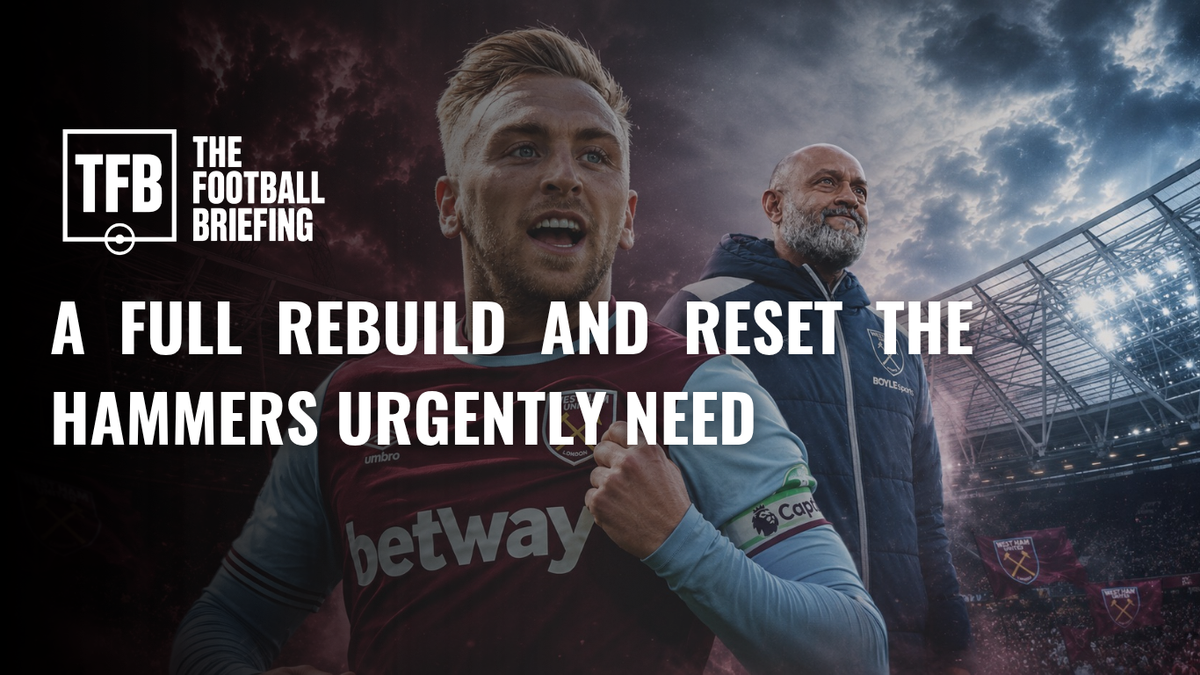
Jarrod Bowen is the player around whom the summer narrative will gather, and understandably so.
On paper, the argument for him leaving is obvious. He is a Premier League-quality attacker, club captain, proven goalscorer and still at an age where he can play elite-level football. The Guardian has reported interest in Bowen from Aston Villa, Chelsea and Everton, while noting that West Ham are desperate not to lose him.
West Ham’s advantage is contractual and emotional. Bowen signed a long-term deal until 2030, which gives the club control rather than desperation. He also has deeper personal ties around the club than most players, including his relationship with Dani Dyer and the wider Dyer family’s West Ham connection. That should not be overstated, but footballers are human beings, not spreadsheets. Family, captaincy, responsibility and legacy can all form part of the equation.
The realistic question is not whether Bowen can be persuaded to commit forever to Championship football. That is unlikely and probably unfair. The more plausible question is whether West Ham can persuade him to stay until January.
That would be a powerful compromise. Bowen could give the club half a season to prove the plan is serious. West Ham could keep their best player through the first phase of the promotion race. Nuno would have a leader who sets the standard. Supporters would see that relegation has not automatically stripped the club of its soul.
But that only works if West Ham are honest with him. They cannot ask Bowen to stay while selling the rest of the spine and replacing it with hopeful punts. They would need to show him a credible recruitment plan, a serious promotion push and a squad built to dominate the division. If January arrives and West Ham are drifting in mid-table, the conversation changes.
Bowen staying would not solve everything. It would, however, change the temperature.
West Ham cannot avoid sales, but they must choose the right ones
The danger for relegated clubs is not selling players. It is selling identity.
West Ham will almost certainly face offers for players who either have Premier League markets, European interest or wage profiles that are difficult to sustain outside the top flight. Mateus Fernandes, Crysencio Summerville and Bowen have all been linked with interest elsewhere, while The Guardian has reported that West Ham need to raise funds and are expected to lose Fernandes.
That is the sort of sale that may become hard to resist. Fernandes has talent, resale value and a profile that clubs above West Ham can easily justify buying. Summerville is another who may attract interest because wide players with pace and one-v-one threat are always in demand.
Then there is the second category: players whose wages or ambitions may not fit the Championship. West Ham need to look coldly at that group. A relegated squad can be poisoned by players who are physically present but mentally elsewhere. Nuno cannot build promotion momentum around reluctant footballers.
But there is a difference between trimming and gutting. West Ham should not treat this as a fire sale unless the finances leave them no alternative. The strongest relegated teams usually keep a core that is too good for the division and supplement it with players who know how to survive the weekly grind. West Ham need to decide which players are part of that core quickly.
Their best route may be selective aggression: one major sale if required, another if the price is exceptional, but no uncontrolled exodus. If Bowen stays, build around him. If he leaves, the club must immediately reinvest in goals, character and Championship certainty rather than chasing a glamorous replacement who sees the move as beneath him.
Recruitment must be built around goals and a spine
Every club West Ham call will know the situation. They will know the parachute-payment perception, the pressure for an instant return and the emotional urgency around the club. That means prices rise. Agents will push. Selling clubs will wait.
West Ham cannot afford to be naïve. They need to recruit as if they are a Championship club with Premier League ambition, not a Premier League club temporarily inconvenienced by a fixture list.
The priority should be simple: goals, durability and a resilient core.
They do not need a scattergun rebuild. They need a centre-forward who can score in awkward games, a central midfielder who can control tempo and take responsibility, and a centre-back who can handle the physical punishment of the division. Promotion is rarely built on vibes. It is built on repeatable strengths.
Here are three players who would make football sense.
1. Žan Vipotnik, Swansea City
West Ham need goals that travel. Not just a striker who can finish when the team are fluent, but one who can turn 0-0 into 1-0 at Preston, Millwall, Blackburn or Stoke when the game is ugly and the crowd is waiting for the relegated club to panic.
Žan Vipotnik fits that brief. Swansea confirmed he finished 2025-26 as the Championship Golden Boot winner and Sky Bet EFL Red Boot winner after scoring 23 league goals.
That immediately makes him difficult and expensive. Swansea also confirmed he has signed a new contract through to 2030, which means this would not be a bargain-market deal. But if West Ham are serious about going straight back up, this is the type of move that changes the division’s perception of them.
Vipotnik would give Nuno a proper focal point. West Ham cannot rely on wide players and moments alone. They need a striker who occupies centre-backs, attacks crosses, finishes second balls and gives the team a target when games become stretched.
The Championship is full of sides who can frustrate technically superior teams for 70 minutes. A striker who has already scored heavily in the division reduces that risk. West Ham have often felt like a club searching for a dependable No 9. In this context, buying Championship-proven goals would not be unimaginative. It would be sensible.
2. Hayden Hackney, Middlesbrough
If West Ham sell Fernandes, they cannot replace him with running alone. They need a midfielder who can give the team rhythm, not just legs.
Hayden Hackney would be a serious statement. He was named Championship Player of the Season for 2025-26, with Middlesbrough reporting that he contributed five goals and seven assists in 38 league appearances.
Hackney’s value is not only in output. It is in personality. He plays like a midfielder who wants the ball when the game is tense. That matters for West Ham because they will face opponents who sit off, break rhythm and force them to be patient. A promotion side needs someone who can keep demanding possession without becoming passive.
For Nuno, Hackney could be the central reference point. He would help West Ham avoid becoming too direct, too emotional or too dependent on Bowen to create something from nothing. He can receive under pressure, connect phases and give the side a measure of Championship authority.
Again, he would not be cheap. Middlesbrough would know exactly what they have. But West Ham’s mistake would be spreading money across several average midfielders rather than securing one who can shape the team. If they want to return at the first attempt, they need at least one player in the middle of the pitch who looks like he belongs at the top end of the division every week.
3. Tristan Crama, Millwall
This would be politically awkward, which is partly why it is interesting.
Tristan Crama was named in the Championship Team of the Season after an outstanding campaign with Millwall. The Analyst also recorded that he started all 48 of Millwall’s Championship matches, a remarkable availability record for a centre-back in such a demanding league.
West Ham need that kind of durability. Relegated sides often underestimate how much Championship football tests defenders. There are long throws, second balls, direct strikers, set-piece routines, quick turnarounds and away grounds that feed off every sign of softness.
Crama would bring size, resilience and evidence that he can handle the division week after week. The Millwall connection would make any deal sensitive and probably expensive, but the football logic is clear. West Ham need defenders who are ready for the Championship as it actually is, not as they hope it will be.
A player like Crama would also help change the mentality of the squad. Promotion is not just about technical superiority. It is about being difficult to beat when the game becomes unpleasant. West Ham have to become harder, more consistent and less fragile. A centre-back with Championship durability and edge would be central to that.
The first ten matches will shape the mood
West Ham open their Championship season away at Burnley on Sunday 16 August, a fixture that immediately strips away any illusion of a soft landing. They also host Norwich on Boxing Day and finish against Portsmouth, with the schedule offering constant reminders that this division will not wait for them to feel ready.
The opening weeks matter because relegation hangovers are emotional before they are tactical. Players are adjusting to smaller stages, different refereeing rhythms, more direct opponents and the psychological shift of being expected to win almost every week. Supporters are judging whether the club has truly reset or simply dropped a level with the same problems attached.
That is where Nuno’s leadership becomes crucial. He needs to make West Ham feel serious quickly. Not spectacular. Serious.
A promotion side does not need to win every game 3-0. It needs habits. Clean sheets. Set-piece threat. A settled midfield. A striker who scores when the performance is flat. A captain who sets the emotional tone. A home crowd that begins to believe the season is not an embarrassment to endure but a campaign to attack.
A crossroads, not a collapse
West Ham are at a crossroads because the easy narratives are all available.
One says they are too big for the Championship and should bounce straight back. Another says the club is broken, the stadium is soulless, the boardroom is unstable and relegation could become a longer decline. Both contain some truth. Neither is complete.
The reality is more demanding. West Ham have enough scale to return immediately, but only if they behave with unusual clarity. They cannot drift through the summer. They cannot let Bowen’s situation hang over the squad until deadline day. They cannot allow governance questions to dominate every football conversation. They cannot buy names when they need functions.
Nuno staying is a genuine saving grace, but it is not a guarantee. Bowen staying until January would be a major emotional and footballing lift, but it would require persuasion, not assumption. Sales may be unavoidable, but they must be controlled. Recruitment has to be ruthless: goals, control, resilience.
West Ham’s biggest question is not whether they can outspend much of the Championship. They probably can. The question is whether they can become coherent again.
If they do, relegation can become a brutal reset rather than the start of a slide. If they do not, the Championship will quickly expose the same problems the Premier League finally punished.